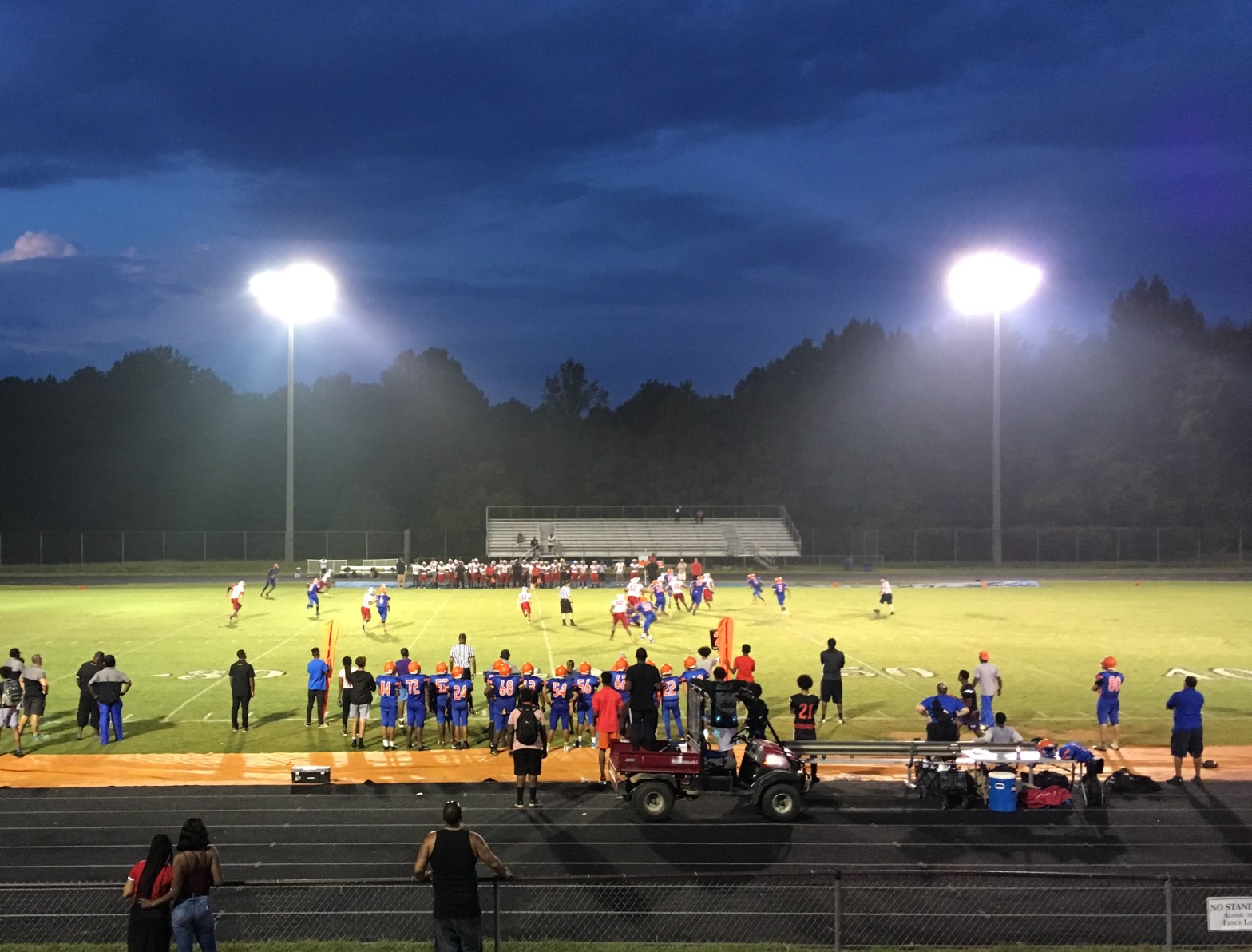
Looking back, I was the least likely football mom. I did not play football and it was not part of my background. Today, I find myself steadfast in defense of my sons’ pursuit of their passion. Life is meant to be lived and tomorrow is not promised. I neither deny science related to concussions, which are not limited to football, nor succumb to the overt judgement of others. Rather than trying to regulate my kids off of the football field, I suggest taking a look at the detrimental effects on kids’ brains of overuse of electronic devices which affect a significantly higher proportion of the population. I respect the freedom for each parent and family to make (or not make) one’s own choices and appreciate the same in return. Consequently, I am compelled to share my perspective, as a football mom, because I love my kids, and I love their passion for the game, which is why I let them play.
I grew up in a small town on the Eastern Shore of Maryland where my alma mater high school has claimed many State Championship titles in various sports, but fielded its last high school football team in 1985, my freshman year. With less than 500 students, the school was unable to field competitive football and boys soccer teams concurrently. Friday Night Lights meant soccer games and cheerleading was limited to basketball season. I played field hockey (for great coaches) and experienced both the thrill of winning and the agony of losing State Championships. But, the American high school football phenomenon was not present in my town.
In the early 90s, I continued my field hockey career at a Division III college where I became teammates with former high school rivals. We made it as far as the NCAA Final Four, but came up short. Our football team struggled to turn in a winning season, but I was friends with several players and attended games. After college, I coached high school field hockey for many years, including seven at a Northern Virginia high school where we practiced adjacent to the football team. Concussions were not yet at the forefront of discussions about football and I did not yet have children. Football had become part of my fall landscape alongside field hockey.
I was an average NFL fan. I played a season of co-ed flag football as a young adult and, as an athlete and natural defender, I admittedly enjoyed the thrill of breaking up a pass play, despite the pain of being bounced like a pinball, even in flag. It was not until I married a former football player that I thought any deeper about what football both demands of and gives to its participants. I believed strongly in the life lessons learned and the leadership skills developed through participation in team sports. Commitment, discipline, communication, determination, perseverance, resilience. The list goes on. My husband asserted there was something greater, different, required by football of boys who became men by playing. I posited that the overwhelming majority of even the U.S. population did not play American football, and could still become good leaders. But, my strong interest in motivation and human behavior made me curious enough to begin information gathering.
Whenever I encountered a male colleague or friend who had played football at any level, I would ask their opinion about football, what they got out of it, and whether it was superior in some way to other sports. Every man agreed. Football was different. The grid iron was the great equalizer. It brought together people of different demographics, demanded toughness, and required performance in unison to accomplish a common goal. One who was a U.S. Marine and All-American Division I lacrosse player described football as most closely aligned with the camaraderie of the military, the need to have your brother’s back and count on him to have yours. For all football participants, but I would argue particularly kids from middle class suburb families, who have never missed a meal or wanted for anything they actually needed, getting in the trenches with others, sometimes coming up short, but learning that anyone not doing their job has consequences for themselves and others, is valuable.
I knew when our two sons were little that, eventually, the topic of football would make its way into our household conversations. Their dad and both of their grandfathers played football and their great uncle even played in the NFL. Considering my sweet baby boys playing this violent game felt uncomfortable and I was thankful I had time. I agreed to their participation in flag football which allowed the boys to learn basic football concepts without the fear of being hit. But, I was relieved when we moved to Asia, delaying the topic for two more years given the unavailability of the sport abroad.
When we returned to the U.S., the boys were entering third and fourth grades. I had (maybe not so) secretly hoped the topic would fade into the background. Nonetheless, it came fast and furious as fall approached. Next thing I knew, the boys were signed up for youth tackle football and I felt anxiety like never before. We often fear that which we do not know. I actively researched the newer coaching techniques taking hold throughout youth football to reduce head to head contact. I asked questions and explored. Upon seeing their first game, I felt somewhat relieved. The other kids were small, like them. It became clear as they got older and the players got bigger that to play scared was to put one’s self and others at risk. The answer was to do it right and do it full speed. That takes focus and courage.
The more I researched, the more I could see the game was changing in order to preserve its own existence. Support and participation were waning, at the youth level. Some organizations folded while others that had been in existence for decades remained in tact, committed to sustaining their traditions. I found myself curious about the parents beside me on the field. Who were these people not judging me, but also being judged by outsiders? It was interesting to look at the demographics of who was allowing their kids to play football, and who was not. Equally interesting was considering their reasons for doing so, whether it was a parent’s dream to have their kid make it to the NFL or more tangibly to make it into a DC area private school through athletic recruitment; or choosing not to allow their son to play for fear that he, and they, would be robbed of whatever future path lay before him. We were allowing our kids to play because they had a passion for the game and wanted to play. The game was giving them more than it was likely to ever take away. It still does and is why we let them play.
Our boys play different positions and are in different age groups, until next year when they will both be in high school. They are both leaders and daily push hard against their personal boundaries. Our oldest is regularly up against kids larger than himself; but, he chooses to be on the field, in the weight room, working hard to get bigger, better, faster, stronger. That drive will serve him well in life. The courage to go out there everyday, taking and incorporating direct feedback on needed improvements, is admirable and frankly lacking among many kids, and ultimately adults, in the workplace today. Our younger son, an introvert who is generally as content at rest as anything, ensures we leave early for football practice, uncharacteristically pointing to the clock as departure time approaches. At practice, he is in his element, whether laying down the play in the huddle or finishing out a sprint. In those moments, it is clear he is where he is meant to be.
Incidentally, over the years, I experienced my own sports injuries, often to the face and head. I took a field hockey ball to the nose (now youth wear goggles), an elbow to the head in basketball, and a field hockey stick to the head in the Final Four. One day at field hockey practice, while working on penalty corners, I took a shot to the leg so hard that tears streamed down my face as the pouring rain hid their presence. The contusion to my leg was so dramatic that the trainers had to mold a customized guard around the apple sized lump to protect it from further injury during several weeks of healing. There is risk in any sport and it is worth the rewards.
People sometimes directly ask “Aren’t you scared letting them play football?” Sure. I am anxious every time any of our three kids step onto an athletic field or court; but, so too is a dance mom or mother of a child doing any kind of performance or sport. That’s a mom thing, not a football thing. Most of us take calculated risks everyday. We get into cars without a second thought, despite statistics that show we are likely to be hurt or killed by or in a car at some time in our lives. People want to get where they are going, so they take the necessary and available precautions, utilizing education, safe equipment and proper technique, and they get in the car. Likewise, I want our boys to get where they are going in life, for however long that is. We apply the same principles because the lessons learned on the football field equipping them for their journey are undeniable.
I fully support the consideration underway to encourage kids to begin with flag football, to learn concepts, begin building their game IQ, and develop basic skills. This may be the future of youth football in America and facilitate consideration by many more families of a complex and unique sport, introducing it in a low contact way.
I was the least likely football mom. But, I ,too, am where I am meant to be. Supporting my boys in one of their greatest passions in life. If anything happened to either of them tomorrow, more likely off of the football field than on, I would take comfort in knowing we allowed him to fully live. To have courage, to take risks, to seek to be part of something bigger than himself, to push his boundaries and to inspire others. Grit can be found on the grid iron. And it translates to life skills that are critical to success and resilience. While many will continue to judge those of us who allow our kids to play football, we will stay focused on the long game. Raising hard working young men who look out for others and know how to take a hit and get back up for the next play in life.
Holly S. Stofa
 Camo and Pearls